Aircraft Detailing at Lugano (LSZA)
Waterless exterior, full interior and protective finishes on the Agno apron—timed around narrow operating windows.
Aircraft Detailing at Lugano (LSZA) serves chief pilots, charter operators and flight-department managers flying light and mid-size business jets into southern Switzerland. The airport sits at 915 ft elevation west of Lugano city, with a single 1,415-metre runway and handling provided by Lugano Airport SA from the main terminal. We perform waterless dry washes, cabin deep cleans, brightwork polishing and ceramic-coating work on the apron, coordinating every turnaround with the handler's office and the airport's published hours—08:00 to 12:00 and 13:30 to 20:00 daily, with a midday break that shapes the day's scheduling.


01/19 · 1415 m
AIP and airport data915 ft
08:00-12:00 and 13:30-20:00 local, Monday-Sunday (landing and take-off); handling office from 07:00
Closed outside published hours; extensions 07:00-08:00 and 20:00-22:00 only with PPR 48 h in advance (surcharge applies)1 on the airport
independent, no affiliationWhat changes at Lugano?
The 1,415-metre runway at LSZA limits operations to light and mid-size business jets and turboprops; the airport has no scheduled airline service and lives entirely on general aviation, with Lugano Airport SA running both the airfield and the handling desk. Operating hours are narrow: landing and take-off slots run 08:00–12:00 and 13:30–20:00 local Monday through Sunday, with the handling office opening at 07:00. Outside those windows the field is closed unless you secure a PPR extension 48 hours in advance—available only between 07:00–08:00 and 20:00–22:00, and it carries a surcharge.
That schedule shapes every on-ramp detail. A quick turn between two legs must fit inside the lunch break or after the first arrival; a multi-hour complete detail needs either a planned overnight or a PPR extension into the evening. The handler expects advance notice of any third-party crew working airside, so we request escort and apron-access clearance through their office as soon as the tech log confirms the stand. At 915 feet elevation the air is denser than at high-altitude fields, but the real constraint is the clock: if the aircraft lands at 11:45 and departs at 14:00, we have ninety minutes—long enough for a dry wash and cabin reset, tight for anything deeper.
Which detailing services work on Lugano's apron?
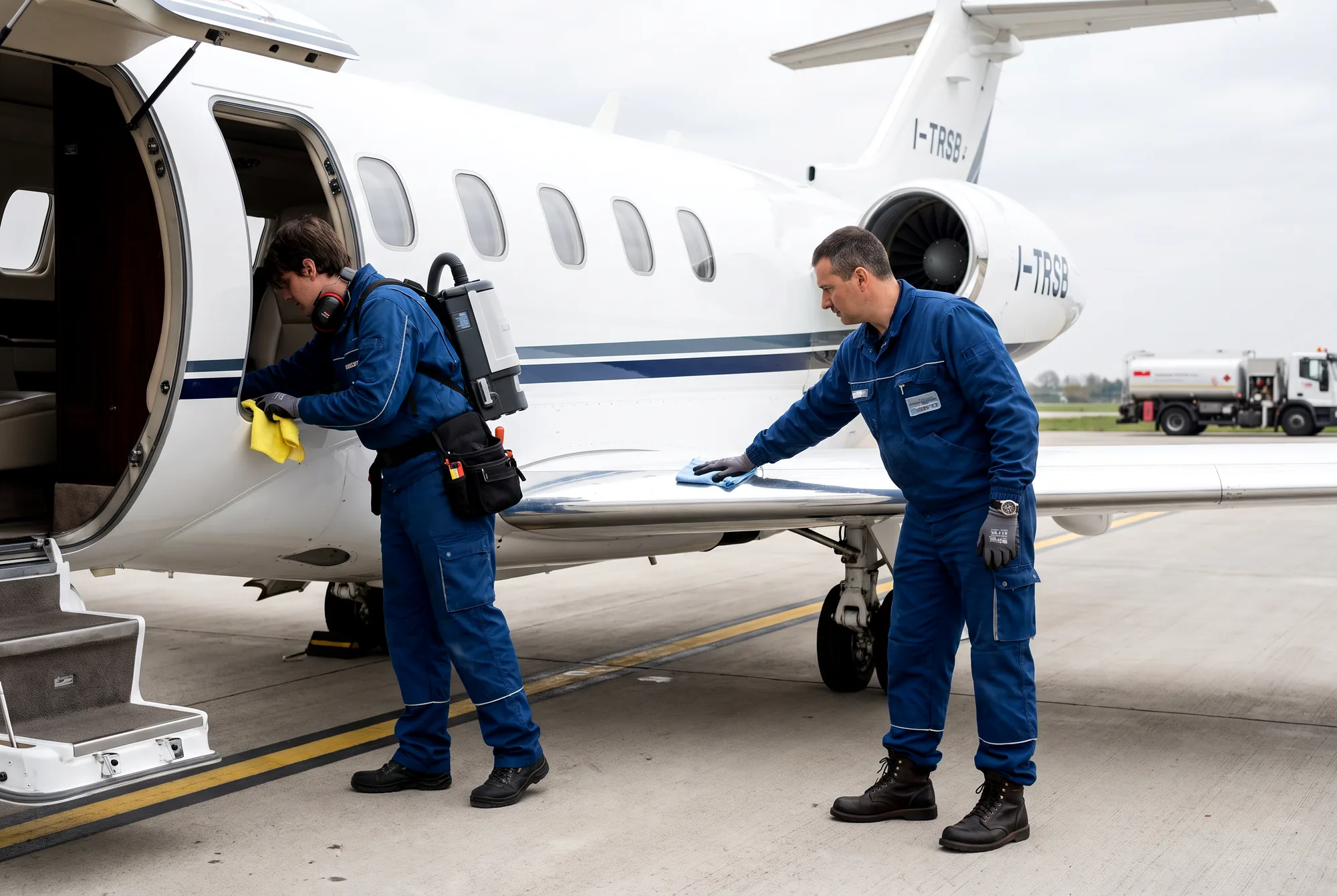
Quick turns fit naturally into the lunch closure or a short layover: we vacuum the cabin, wipe galley and lavatory surfaces, clean windows inside and out, and run a waterless exterior over the fuselage and nacelles. The job takes sixty to ninety minutes and leaves the aircraft flight-ready without a drop of rinse water. An exterior dry wash covers the same ground on the outside—degreasing the belly, cleaning leading edges and gear doors, dressing tyres—and suits any ramp where mains water is restricted or where the apron has no wash pad.
Full interior details happen during longer stops: we pull seat cushions and belts, steam-clean carpets, condition all leather, polish veneer, wipe down sidewalls and treat the galley and lavatory to a deep scrub. Brightwork polish brings spinners, engine inlets and bare-metal leading edges back to a mirror finish by hand. A complete detail combines exterior wash, paint decontamination, single-stage polish, brightwork, full cabin and disinfection—typically an overnight job. Ceramic coating requires two days: one for paint correction and brightwork prep, a second for layer application and cabin work while the coating cures. Cabin disinfection alone takes two hours, sanitising high-touch surfaces and the air path with no-touch methods around avionics. Fleet-care programmes suit based aircraft: scheduled quick turns, monthly interiors, quarterly polish and an annual ceramic refresh, all logged in a twelve-month plan.
How do you coordinate with the handler at Lugano?
Lugano Airport SA runs both the airfield and the handling desk, so every request—stand assignment, GPU, airside escort, apron access for a third-party crew—flows through one office. We notify them as soon as the operator confirms the arrival slot, providing crew names, passport numbers and the scope of work. The handler issues temporary airside passes and arranges an escort if our team does not already hold LSZA-stamped credentials. On the day, we check in at the handling office from 07:00 onward, collect the escort and drive to the stand once the aircraft is chocked and the captain signs the tech log.
Because the airport closes between 12:00 and 13:30, any detail that spans the lunch break must pause: we secure tools, cover open panels and leave the aircraft locked until the field reopens. If a complete detail or ceramic job runs past 20:00, the operator requests a PPR extension at least 48 hours ahead; the surcharge is passed to the client, and we adjust our crew's schedule to match the approved window. The handler also confirms whether mains water is available on that stand—though we default to waterless methods at LSZA—and whether waste disposal for used microfibre and polish residue can be arranged through the terminal or must travel off-site with us.
What does the Alpine climate do to paint and cabin?
Lugano sits in a pre-Alpine bowl at the northern foot of the Swiss–Italian lakes; winters are cold enough for frost and occasional snow, summers warm and humid. Aircraft parked overnight on the apron collect dew in spring and autumn, and that moisture sits on paint and in panel gaps until the morning sun burns it off. If the paint lacks a hydrophobic top layer, the water beads slowly and leaves mineral rings; if the aircraft has flown through de-icing fluid earlier in the season, residue mixes with the dew and forms a hazy film that needs a decon pass before any polish will bite.
Inside, the cabin alternates between cold-soaked mornings and warm, stuffy afternoons when the aircraft has sat in direct sun. Leather dries out faster in low humidity, veneer shows dust more plainly, and galley seals can harbour condensation if the aircraft was catered and then left unpowered. We pre-treat all leather with pH-neutral cleaner and a conditioning emulsion, steam carpets to lift embedded grit, and wipe veneer with a microfibre barely damp so the grain does not swell. Brightwork on the nacelles and leading edges oxidises more slowly in the cool air than it would at a desert field, but road salt tracked onto the apron in winter will pit spinners and exhaust cones if it sits for weeks, so a quarterly polish schedule keeps corrosion at bay.
How long does a complete detail take at LSZA?
A complete detail—exterior wash, decontamination, single-stage polish, brightwork, full interior and disinfection—runs eight to twelve hours depending on the size of the aircraft and the condition of the paint. For a super-midsize jet that has flown through a European winter, we budget ten hours: two for the exterior wash and clay-bar decon, three for machine polishing the fuselage and tailcone, one for brightwork by hand, three for the cabin deep clean and one for disinfection and a final walk-through.
At Lugano the ten-hour span must fit the published operating window or straddle it with a PPR extension. If the aircraft lands at 08:30, we can work straight through until 20:00 with a pause at lunch—tight but achievable for a mid-size jet in reasonable condition. More often the operator plans an overnight: arrival late afternoon, detail work from 14:00 the next day through to 20:00 or 22:00 with an extension, departure the following morning. Ceramic coating always needs two days—day one for paint correction and prep, day two for application and cabin work while the coating cures—so the aircraft remains on stand for at least one full night and parts of two days. We confirm the timeline with the handler when we request apron access, and the operator includes the extension surcharge in the trip budget if the work runs past the standard 20:00 closure.
Why choose Terso for aircraft detailing at Lugano?
We have cleaned business jets at regional Swiss fields long enough to know that narrow operating hours and a single handler demand tighter coordination than at a hub with round-the-clock ramps. Every detail at LSZA begins with a call to Lugano Airport SA to confirm the stand, the arrival slot and whether a PPR extension is needed; we submit crew documents for airside passes, arrange the escort and schedule our arrival to match the aircraft's chocks-on time. On the apron we work with waterless products as the default—no mains hookup, no runoff—so the handler never worries about environmental compliance or apron drainage.
Our team carries every tool in the van: dual-action polishers, microfibre by the dozen, pH-neutral cleaners, leather conditioner, brightwork compound, ceramic-prep solution and disinfectant misters. We log every job—products used, areas treated, hours on stand—and send the report to the flight department before the next leg. If the operator wants a fleet-care programme for an aircraft based at Lugano, we build a twelve-month schedule around the airport's seasonal rhythm: monthly quick turns and interiors during the busy summer charter season, quarterly polish in spring and autumn, an annual ceramic top-up in winter when the aircraft sits longer between trips. The goal is simple: the jet leaves Lugano cleaner than it arrived, the handler's office has no surprises and the chief pilot has one fewer item on the trip sheet.
Questions operators ask about detailing at Lugano
Can you detail an aircraft at Lugano outside normal operating hours?
Only if the operator secures a PPR extension 48 hours in advance, available 07:00–08:00 and 20:00–22:00 with a surcharge. The airport is closed to movements outside 08:00–12:00 and 13:30–20:00 daily. Extensions into the early morning or evening require PPR approval at least two days ahead and carry an additional fee. We coordinate the request through the handler and adjust our crew schedule to match the approved window.
Do you use water on the apron at Lugano?
We default to waterless dry-wash products; mains water is used only if the handler confirms availability and drainage on that stand. Most detailing at LSZA is performed with aviation-approved waterless cleaners and microfibre, producing no runoff. If a traditional rinse wash is requested and the stand has a mains hookup, we confirm environmental compliance and waste-water routing with Lugano Airport SA before starting work.
Which business-jet types can you detail at LSZA?
Light and mid-size jets and turboprops that fit the 1,415-metre runway—Phenom, Citation, Learjet, Challenger 350, Praetor, King Air and similar. The runway length limits operations to lighter business aircraft; we have detailed everything from a Phenom 100 to a Challenger 350 at Lugano. Super-midsize and larger jets typically use Zurich or Milan; LSZA serves the regional and owner-flown market across Ticino and the Italian lakes.
How far in advance should we book a complete detail at Lugano?
At least one week for a complete detail, two weeks if ceramic coating or a PPR extension past 20:00 is required. A week's notice lets us reserve crew, confirm airside access with the handler and arrange any evening extension with the airport. Ceramic jobs need two days on stand, so the operator must also confirm overnight parking and GPU availability. Quick turns and dry washes can often be arranged with 48 hours' lead time if the schedule permits.
What happens if the aircraft lands during the lunch closure?
We pause work at 12:00, secure the aircraft and resume at 13:30 when the field reopens. The midday break is firm: no movements and no handler staff on the apron between 12:00 and 13:30. If a detail is in progress, we lock the cabin, cover any open panels and return when operations restart. The pause adds no cost but does extend the total elapsed time, so we factor it into the day's timeline.
Can you detail an aircraft based at Lugano on a monthly schedule?
Yes; we build a fleet-care programme around the airport's operating calendar and the aircraft's utilisation pattern. A typical plan includes a quick turn and interior vacuum every four weeks, a full interior detail each quarter, brightwork polish twice a year and an annual ceramic refresh. We log every visit, track paint condition over time and adjust the schedule if the aircraft increases winter flying or sits idle for weeks in summer.
Do you need an escort to work on the Lugano apron?
Yes, unless our crew already holds LSZA-stamped airside credentials; the handler arranges the escort when we request apron access. Lugano Airport SA issues temporary passes and provides an escort for third-party crews. We submit passport details and the scope of work in advance, check in at the handling office on the day and are escorted to the stand. Once the detail is complete, the escort signs us back out through the terminal.
What does a dry wash include at LSZA?
Waterless cleaning of the entire exterior—fuselage, wings, nacelles, tail, belly, gear doors and tyres—using aviation-approved spray and microfibre. We spray small sections at a time, lift dirt with a clean microfibre, then buff to a streak-free finish with a second cloth. Leading edges, the cheat line and the belly receive extra passes. The process takes ninety minutes to two hours for a mid-size jet and leaves no water on the apron.
Can you polish brightwork in winter at Lugano?
Yes, though we work inside a heated hangar if temperatures drop below freezing, or wait for a warmer afternoon on the apron. Polishing compound does not work well on cold metal; below about 5 °C it smears rather than cuts. If the forecast is cold all day, we ask the handler whether hangar space is available. Otherwise we schedule the job for a milder week or perform it in spring when the apron warms naturally by midday.
How do you handle waste from a detail at Lugano?
Used microfibre, polish residue and spent disinfectant go into sealed bags; we either dispose through the terminal or take them off-site, as the handler directs. Lugano Airport SA will confirm whether waste bins for non-hazardous detailing materials are available on the apron or inside the terminal. If not, we load everything back into the van and dispose at an approved facility off the field. No residue is left on the stand or rinsed into apron drains.